Game Theory Vs Game Design
A common misconception that can come up when conversing with people outside the commercial games industry is a false understanding that game theory and game design are the same discipline. While they can overlap, game theory and game design are different fields that usually don't interface with each other.
So I'll quickly explain what game theory is and how it contrasts to game design.
Game Theory
Game theory is the science of studying and modeling human behavior using mathematical systems when multiple (usually two) parties or players are involved. Decisions made by individuals usually need to take into account decisions made by an opponent or other parties.
Game Theory systems are representation of abstract situations created for modeling real life outcomes. Choices are usually mapped out in a matric or flow chart with number values associated with each choice axis: one per player (or party). Each option represents a strategic choice and a payoff. Each player is assumed to be rational and logical within the system making the best choice for their individual situation. Game Theory is used to find the most optimal strategy for either one or all players.
Cake Cutting Game
A basic example that explains some of the concepts of game theory is the Cake Cutting Game. Consisting of 2 players it involves a cake cutter and a slice chooser.
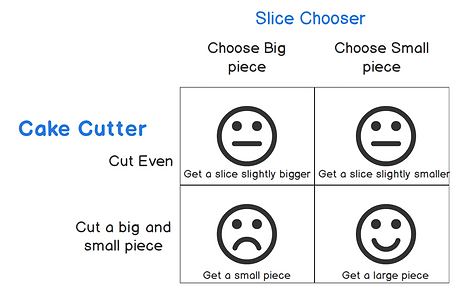
The Cake Cutter has to think about what piece of cake they want but also about what the slice chooser will do. Clearly cutting a big slice and leaving a small one might seem logical for the cake cutter if the choice was made in a vacuum. But the prediction that the slice chooser will take the big piece leaving the cake cutter with the smaller one instead makes the cake cutter try to cut as even as possible. Here is an abstract payout matrix of the cake cutting game:

The cake cutting game is known as a zero-sum game. This is a term to mean that the winner takes directly from the loser. There is no added value shared or grown within the situation. Numbers in the payouts are approximations and are used to highlight the differences between the strategies. Player 1’s first strategy will only gain or cost 1 point, while the second strategy will gain or cost 10 points. Cutting evenly has a much lower risk (or gain) than cutting a large and a small piece.
Game Theory is useful in explaining why someone who can choose to cut any size cake winds up cutting as evenly as possible. Essentially, it is a mathematical way to comprehend empathy. Players have to think not only of the best individual payout, but predict what actions their opponent may take. This field breaks down complex human actions into binary situations that can be explored with computer system and mathematical equations.
The Prisoner's Dilemma
Not all confrontations are zero-sum. The Prisoner's Dilemma demonstrates why two rational thinking players might want to cooperate even if it isn’t in their best interest to do so.
Two members of a criminal gang are caught by police. Each one is in solitary confinement with no means of communicating with one another. The police lack evidence to convict the gang members on the most serious punishment but enough for a lesser punishment. The police offers each member, separately, a plea deal. If they betray the other member, they can go free and the other member will be charged with the most serious punishment. The dilemma is that if both players are perfectly rational, they would choose to betray the other since that is in their best interest. However, if both of them do so, they will get the worst outcome. Therefore, remaining silent is the best outcome for both of them. In this case, being cooperative is better than operating on an individually rational strategy.
In this matrix, the first number in the payout represents prisoner 1 and the second is the payout for prisoner 2. Notice that the payouts vary based on the decisions made and do not represent a zero-sum game.

The Prisoner’s Dilemma is used in real world situations where cooperation is the best outcome for both parties, even when it’s difficult or expensive to do so. In fact it was models like this that helped policy think-tanks and political forces on both sides reach a truce in high stakes nuclear proliferation efforts during the cold war.
Rational vs Human, Theory vs Practice
In more recent decades, many economists and psychologists question the underlying assumption that game theory makes: that the parties involved are acting rationally and logically. Most psychology research suggests that humans do not always act rationally, making the predicted behavior of game theory much less reliable.
However, game theory itself might explain why we evolved to think in irrational ways and to help us understand those limits of rationality.
The Game of Chicken
Two cars are speeding down a single lane road. The first to swerve away yields the road to the other, but if they both don’t swerve the results are catastrophic. In this game, a winning situation is not to swerve. However, swerving is far better than crashing. Here is the game matrix:

As time passes, the stakes get higher increasing the pressure on both parties to swerve. In this game, a counter-intuitive fact is that if one party limits their choice to swerve, they can force the other parties' hand. Of course that means they need to display some kind of irrationality like throwing their steering wheel out the window. Once a handicap is shown, the second party is more likely to swerve.
John Maynard Smith and George Price used a model similar to understand animal behavior for mating, hunting, and nesting when competing with others. In their paper, "The Logic of Animal Conflict" they discuss a similar model called Hawk vs Dove, where they explore why animals usually do not use their most powerful attacks in situations of competing resources. Evolution is about passing on the most successful genes, so using deadly force would seem optimal from an individual level. Their paper concluded that the model of Hawk vs Dove was able to explain why animals evolve to display threats without much injury, and why animals that evolved to change up their behavior (being unpredictable) when engaging in such confrontations would be more likely to pass their genes on. Avoiding the use of deadly force (or crash) was too high a risk for both parties involved and therefore smaller threats are used to cause the other party to yield.
Predictably Irrational
While the game of chicken can show us how irrational behavior can be used to our advantage when competing with limited resources, this can only explain one aspect of how we think. Most modern psychology research tells us that in an effort to save energy, we take the path of least (neural) resistance. We rely on biases and intuition to make quick assessments, which makes interpreting the world around us quick and energy-efficient. Understanding how humans think and act is important for any designer, and shows the potential contrast between game theory and game design.
Game Design
Game Design is a design discipline for creating game systems. This term is sometimes bundled with visual design, aesthetics or programming functional components, however these are separate from the actual system design. Game design more readily crosses over into UX (User Experience) and Instructional design, separate disciplines that shares many traits.
A game designer focuses on creating a game system that provides a clear and impactful or positive player experience, balanced for an optimal level of challenge or engagement throughout. The goal for a game designer is to create a system that evokes emotions, feelings, and behaviors, rather than to model real world behavior under logical or mathematical principles. Playing the Prisoner's Dilemma isn’t intended to be an engaging experience, but it is an important tool to understand mathematically how cooperation works.
Game Types
Games come in many forms and rarely do game systems reflect those used in game theory. They are almost always more complex, with choices and payoffs not tied to a binary outcome, or payoff matrix. Crafting the right experience means that designers will draw inspiration from intrinsically motivating activities, experiences or behaviors they wish to encourage or introduce to players.
Not all games need to be fun but they do need to be engaging. If the desired goal is to experience empathy, understanding or feeling a particular emotion, then the game system is designed to have that impact. The system offers the player a series of meaningful choices and feedback. Every choice has a consequent feedback: event, impact, score, or the limiting, expanding or changing of future choices. These choices and their feedback are designed to enhance the engagement and serve the desired goal.
Flow
Game designers craft or break flow in their game systems by the choices, paths and blocks they put in front of players. Flow is a state where the challenge level is balanced so that the player is engaged but not frustrated. If the game system gets too hard too fast, players will get frustrated; too easy and players will be bored. The system needs to change over time to accommodate different (and evolving) player skill sets and expectations.

Learning as Playing
As in any type of design, the game system should communicate to the player what options are available, what the challenges are, and how to navigate through the system.
Most design principles allow for easy communication of teaching and use. When these are lacking, users are frustrated and misuse the product. A common example is called Norman Doors named after Don Norman, author of The Design of Everyday Things. A Norman Door is a door that fails to communicate quickly how to operate it. It uses confusing, conflicting or wrong schemas which communicate the wrong action, such as a pull handle when only push is allowed. We’ve all experienced these doors and sometimes blame ourselves for not knowing how to perform the simplest of tasks, but these are glowing examples of poor design.
These design principles get at the heart of why understanding how humans think is important. When we come across a door, we don’t stop and analyze how to open it beforehand. We have built overtime a subconscious set of schemas or patterns to help us understand when to push or pull a handle. Without thinking, we will look at the form of the handle and make a fast guess on what our actions are. Only when our action fails do we stop and reassess the situation.
Likewise, game design that doesn’t include teaching as part of its system isn’t optimal. Good game design provides tutorials that are seamlessly integrated into the entirety of the game system. Understanding how we hold new ideas and concepts in short term memory, using consistent and predictable interfaces, schemas and iconography is all part of game design. Using these broad design principles, game designers can reinforce or stress certain strategies or choices over others or predict and alter player behavior in the game system effectively.
Playing as Learning or Training
By providing a space to experiment and learn through the feedback of choices made, players are more apt to retain the information as the experience is memorable and enjoyable. The stress here is not that the score be the best. There is value in allowing players to explore extremes in strategy and making mistakes as it gives them appropriate outcomes. Not restricting choices is important. If a choice can be made in the real world, it should be an option for players. Part of the fun is exploring those outcomes that can happen when uncommon choices are made. Play within the system allows them to learn the impact of choices in a safe space before deploying those strategies in the real world.
A quiz or guided video learning demo doesn’t have the same impact because it doesn’t allow for experimentation, for asking questions and for learning from failure. Concepts are isolated from the complexity of real world problems and don’t allow for context. Game systems can correct these shortcomings.
Recap
In game design, a designer is crafting a game system. In game theory, a game system is used to learn about mathematical outcomes to explain real world human behavior and interaction. Game theory can be an important tool for game designers to model optimal options in certain systems or to draw out interesting confrontations and challenges, but the design aspect is different. The design of games is more than just a mathematical concept although mathematics is often used in game design. Good design principles, an understanding of highlighting intrinsically motivating activities within the goal of the game experience, and the understanding of psychology are important when making games that inspire, teach and motivate players.
References:
Thanks to Frank Lantz for his great work and interesting talks. His Strange Love talk in particular helped in the writing of this post.
Frank Lantz: Strange Love or the Relationship Between Game Theory and Game Design
William Spaniel Game Theory 101: Tying Hands/Burning Bridges